Data Realities – IoT & mmWave Radar Sensor Fleet Platform
FS04 is an enterprise IoT platform designed to connect, manage, and process real-time telemetry from over 100,000 devices. At its core, the system ingests continuous binary data streams from 60GHz mmWave Radar (FMCW) sensors, providing spatial presence detection, multi-target trajectory tracking, and high-precision monitoring.
1. Architectural & Engineering Highlights
- Edge Device Client (Go & Web Serial): The
fs04_deviceGo client interfaces directly with mmWave sensors over USB Serial (9600 baud, 8N1). Custom binary protocol parsers decode spatial X/Y coordinates and distance for up to 8 concurrent targets at 200ms polling intervals. - Interactive 3D Visualizer (Three.js): The client-side dashboard renders targets within a 3D coordinate space via Three.js, projecting movement history trails and zone boundaries (Zones A/B) with ultra-low latency.
- Decoupled Real-Time Proxy (Pushpin): Sits at the edge to maintain open WebSocket and SSE connections using GRIP headers (Grip-Hold, Grip-Channel), offloading stateful socket management entirely from the SvelteKit backend.
- High-Throughput Analytics Pipeline: Workload isolation between PostgreSQL (relational metadata, ZenStack/Prisma RBAC) and ClickHouse Columnar Storage. Ingested raw telemetry passes through Redis Streams and Vector pods into ClickHouse Materialized Views, delivering sub-50ms queries across hundreds of millions of events.
- MQTT Batch Publishing (500x Acceleration): Clustered publish algorithms batch messages into 1,000-device chunks, reducing 100k-device broadcast latency from 30 seconds down to 0.06 seconds.
2. Role & Key Responsibilities
As Lead System Architect & Core Developer, Justin Dang spearheaded the end-to-end real-time communication stack, hardware binary protocols, ClickHouse schema design, and Kubernetes cloud infrastructure on GCP.
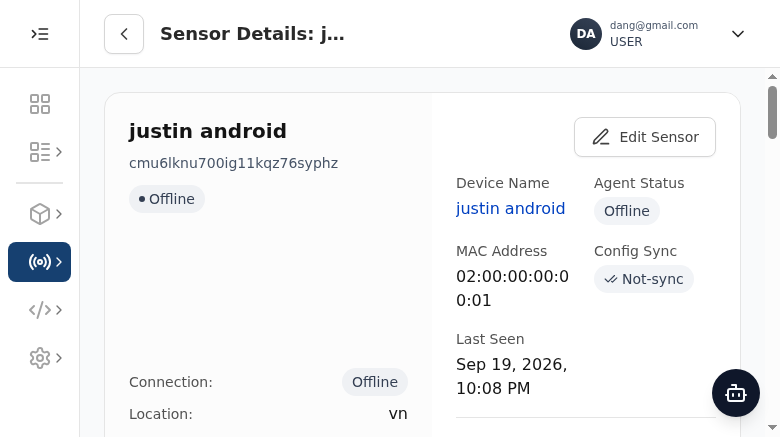
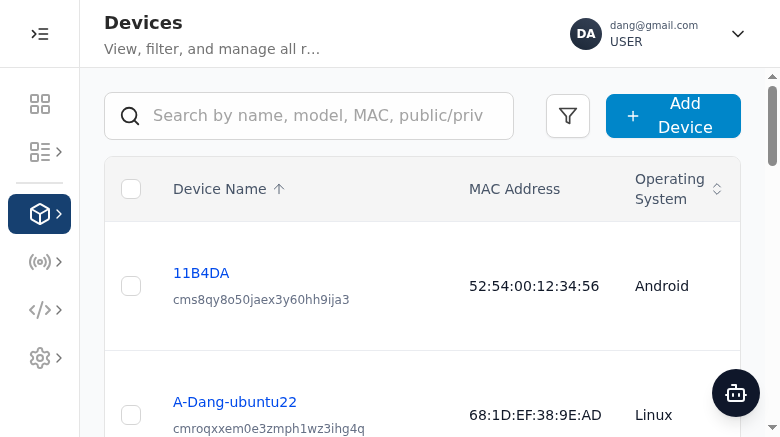
Real-World Interface: Radar Live Preview & RDM Fleet Management
Below are live captures from the production interface of Data Realities, highlighting the Sensors IoT subsystem and Remote Device Management (RDM) architected by Justin Dang: