
Internal emails obtained by Thương nhân trong cuộc reveal that these 7,000 people were selected to join an initiative directly launched by CEO Mark Zuckerberg, with the goal of boosting Meta’s position in the global AI race.
Many employees will be part of the Applied AI (AAI) team, established by Meta earlier this year and led by Vice President of Engineering Maher Saba, reporting directly to Chief Technology Officer Andrew Bosworth. Others will be deployed to teams specifically focused on AI agents, such as the “Agent Conversion Acceleration” or “Agent Data and Optimization” teams.
“This reflects your influence,” the email stated, explaining that the recipient was chosen for “high performance and technical competence, capable of making a difference to the new team.”

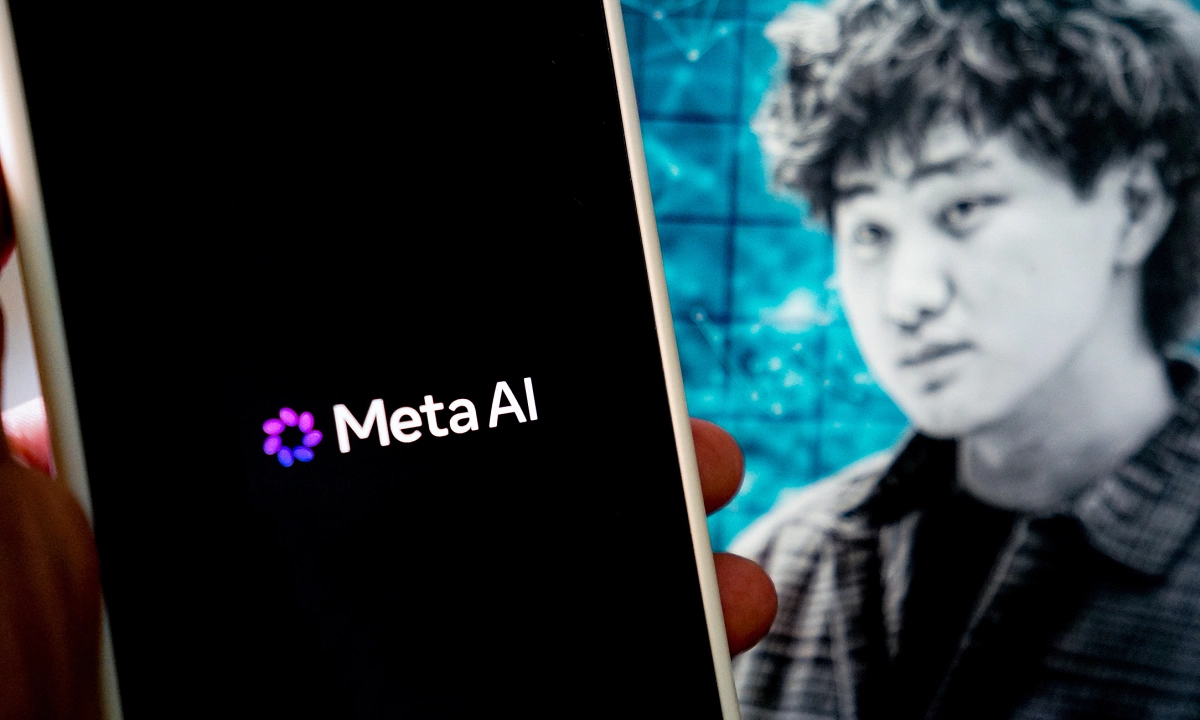
The Meta AI logo on a smartphone, with Alexandr Wang, Meta’s AI Director, in the background. Photo: Bảo Lâm
On May 20th, approximately 8,000 people, equivalent to 10% of Meta’s workforce, began receiving layoff emails. They were told the cuts were intended to “compensate for other investments” by the company. Against this backdrop, the reassignment to the AI department offered a glimmer of hope to many workers fearing job losses.
Meta is undergoing a series of large-scale reforms, such as establishing a superintelligence research lab, organizing small teams dedicated to AI, and changing the job titles of some departments to “AI builders.” This is because Meta’s AI model still lags behind competitors like OpenAI and Google, so the company’s leadership needs to find ways to mobilize personnel to train a better model.
Joining the new initiative is a “non-negotiable” move. Four anonymous employees said many people received the news in mixed feelings of relief, fear, confusion, or shock.
“I was forced to join,” wrote one person on Meta’s employee-focused Discord server discussing the layoffs. The Blind platform was also flooded with posts from those selected to join AAI, some questioning the department’s actual role.
Two Meta employees said these AI teams are likely to be responsible for data labeling, a job typically done by low-cost labor, which requires reviewing each image for annotation or correcting errors in chatbot responses. This is an area where Alexandr Wang, Meta’s AI director, has extensive experience. He is the co-founder and former CEO of Scale AI, one of the world’s largestdata labeling companies, but they rely heavily on subcontractors to train their AI.
A Meta spokesperson declined to comment on the information.
An internal company memo from April indicated that AI models still lack the necessary knowledge to surpass humans in many technical areas such as programming. “Models need to be trained using real-world examples so they understand how humans actually accomplish tasks,” the memo stated.
In a leaked recording of an internal Meta meeting last month, Zuckerberg said Wang understood data labeling very well. He also frankly stated that Meta employees “are far more intelligent” than contractors, expressing a desire to mobilize top talent across the company to train the AI model.
“This would be a huge advantage if we could do it,” Zuckerberg said at the time.
Trước đó, theo Reuters, Meta also deployed several other AI initiatives, such as the Model Capability Initiative (MCI) tool, which tracks employees’ mouse and keyboard movements. MCI operates on work-related applications and websites. Besides collecting data, it also periodically takes screenshots of employee screen content. The goal is to improve its ability to simulate how humans interact with computers, such as selecting from dropdown menus or using keyboard shortcuts.
A number of Meta employees distributed flyers expressing their dissatisfaction. “You don’t want to work at the Employee Data Extraction Factory, do you?”, the flyer stated, encouraging signatures on a petition protesting the installation of mouse and computer tracking software.
When asked about the situation, Andy Stone, a Meta spokesperson, said: “If we’re building agents to help people complete everyday tasks using computers, then the models need real-world examples of how they use the computer, such as mouse movements, button presses, and interacting with dropdown menus.”
“Meta employees are paying the price for the reckless and costly gambles of the leadership team. While executives pursue a speculative AI strategy, employees face severe job cuts, draconian supervision, and the harsh reality of having to train an inefficient system that will soon replace them,” Eleanor Payne, a member of United Tech and Allied Workers – a union founded by a group of Meta employees in the UK – told Reuters .
Compiled by Diệp Anh
 VI
VI  EN
EN
Trả lời
Bạn phải đăng nhập để gửi phản hồi.