The trial began on April 28th at a federal court in Oakland, California, and concluded its arguments on May 14th. The nine-person jury began deliberations on May 18th to determine how OpenAI should be restructured, the amount of compensation to be paid—potentially up to $150 billion if Musk wins; or whether there will be no remedy if Musk loses.
NBC News noted that the past three weeks have also shed light on how American courts judge billionaires and the wealth of those involved. “This is probably the most contact between billionaires and ordinary people in about 10 years,” commented Catherine Bracy, CEO of TechEquity, an organization advocating for and addressing inequality created by the tech industry, and one of the attendees at the trial.

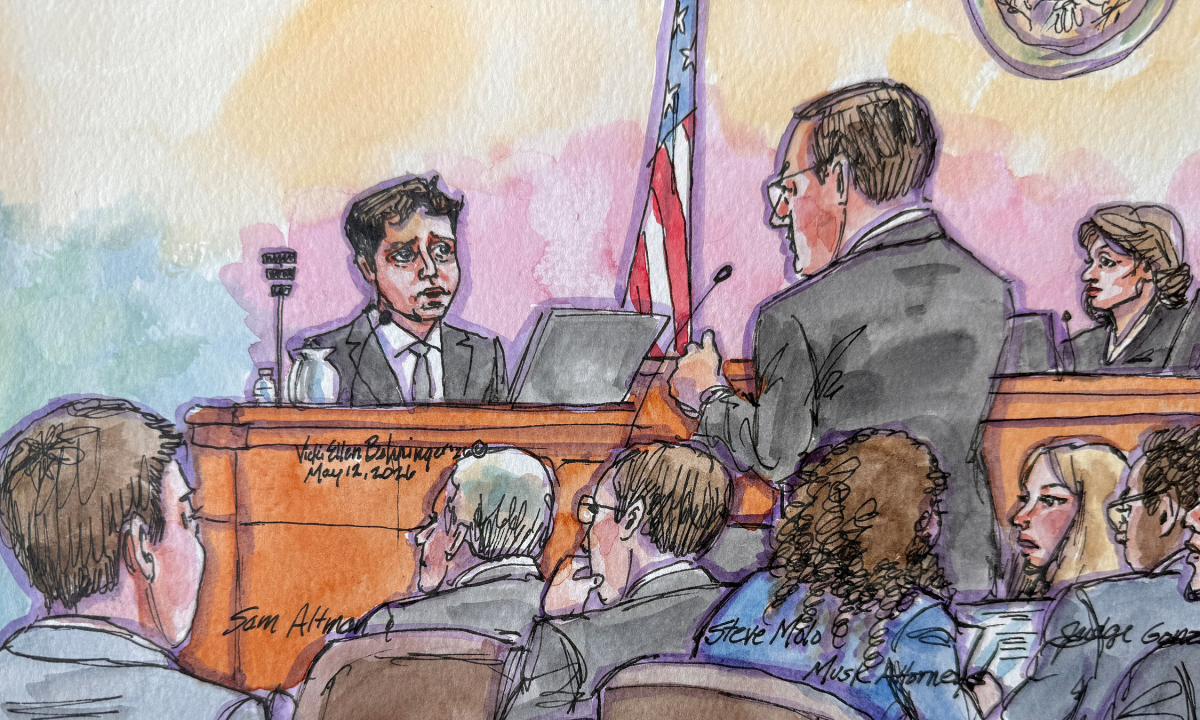
A Reuters sketch depicting OpenAI CEO Sam Altman being questioned by Elon Musk’s lawyers.
Despite lasting over half a month, the courtroom was always packed with senior lawyers from both sides, along with witnesses who were prominent figures in the tech world. According to Wired , when a billionaire wanted to pass through a public hallway or elevator, security personnel had to clear the way. Some even used luxurious cushions to sit on the hard wooden chairs in the courtroom.
Meanwhile, according to CNBC , due to receiving several death threats before the trial, Sam Altman and Elon Musk were allowed to enter the building through a back door, bypassing the throngs of photographers. However, the two billionaires were still required to go through the same security checks as everyone else.
Judge Yvonne Gonzalez Rogers summarized the trial with the phrase “billionaire versus billionaire.” Before beginning, she pledged not to let wealth influence the court’s proceedings. “The fact that some parties and witnesses have significant influence does not mean they are entitled to special privileges,” Rogers said.
On the witness stand, the billionaires took turns being questioned. In the second week, Steven Molo, Musk’s lawyer, asked OpenAI co-founder and chairman Greg Brockman whether his stake in the company was valued at $20 billion. Brockman confirmed it, even saying it “could be true” when referring to the $30 billion figure.
Molo called the $30 billion “an example of ill-gotten wealth,” accusing Brockman and OpenAI CEO Sam Altman of enriching themselves through shady dealings within a non-profit organization originally founded with the mission of developing safe AI for humanity. “Brockman never invested a penny here,” Musk’s lawyer stated in court.
“He has made billions of dollars through hard work and taking risks,” countered Bill Savitt, OpenAI’s lawyer.
In fact, many of those present at the trial were billionaires. According to Bloomberg, Brockman was the second wealthiest person to testify in the case. The top performer was Musk with $814 billion, followed by OpenAI co-founder Ilya Sutskever with $7 billion, Altman with $3.4 billion, and OpenAI Chairman Bret Taylor with $2.5 billion. Microsoft CEO Satya Nadella also possessed a fortune of $1.3 billion. Additionally, several witnesses were absent and gave testimony via video, such as Facebook co-founder Dustin Moskovitz ($9.9 billion) and LinkedIn co-founder Reid Hoffman ($2.7 billion).
Regarding Altman, although he doesn’t directly own shares in OpenAI, he holds significant stakes in companies that partner with the startup, totaling over $2 billion . According to Forbes estimates, Altman amassed a net worth of $4 billion through venture capital investments before and during his time at OpenAI. Musk’s lawyers argue that, with these “insider” investments, Altman violated trust and enriched himself unjustly. The OpenAI CEO denies the allegations, stating that he “actively withdrew” from important discussions with the companies he invested in.
Outside the courthouse, hundreds of people gathered to protest or support the billionaires. They set up props mocking Musk, Altman, or both. “He’s getting crazier, more extreme, racist, and it’s driving me crazy,” said one man named Keith, referring to Elon Musk, but adding that he also didn’t support Altman, OpenAI, or Microsoft.
In the final days of the third week, Musk did not attend the closing remarks because he was accompanying US President Donald Trump on a state visit to China. Lawyer Molo apologized to the jury for this.
Back inside the courtroom, Judge Rogers was perceived as strict despite being surrounded by influential figures. Richard Marcus, a law professor at the University of California, San Francisco, said he was impressed by the judge’s unwavering approach, despite the courtroom being filled with wealthy individuals accustomed to being pampered.
“She completely dominated the courtroom,” Marcus said.
Throughout the trial, Ms. Rogers also praised the jury for being composed of people from diverse backgrounds rather than those “of the same social class,” alluding to the contrast between them and the billionaire witnesses and plaintiffs. “We have ordinary people judging the credibility of witnesses,” she said on May 14.
According to NBC News , it is unclear what will happen if the jury concludes that OpenAI and Microsoft acted wrongly during the restructuring process. In the lawsuit, Musk requested a permanent injunction to “respect the commitments in the original charter upon which the non-profit OpenAI was founded,” as well as an injunction to remove Altman and Brockman from the company that owns ChatGPT.
Bao Lam compilation
- A series of revelations by the ChatGPT boss during the trial where
- Altman was accused of lying, Musk criticized for ‘selective amnesia’,
- Sam Altman ‘revealed’ over $2 billion in assets from OpenAI partners,
- Sam Altman: ‘Elon Musk wants to own 90% of OpenAI’
- , ‘The hidden side’ of Elon Musk and Sam Altman’s personalities,
 EN
EN  VI
VI
Leave a Reply
You must be logged in to post a comment.